
Hoover Dam Tour Guide Explains Why the Dam Still Matters
by John Robert Adair
Water is not a “cool or sexy” subject … at least that’s the way many politicians see it. So they
rarely talk about the dangerously low lake levels at Lake Mead. That’s the main body of water
—-at one time the largest reservoir of water in the U.S.—-and the primary source for 90% of Las
Vegas’ water supply. The other 10% comes from well water.
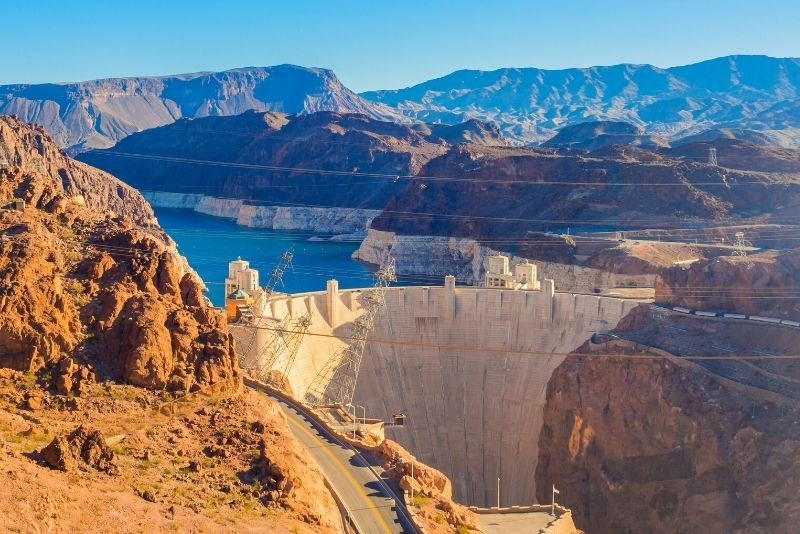
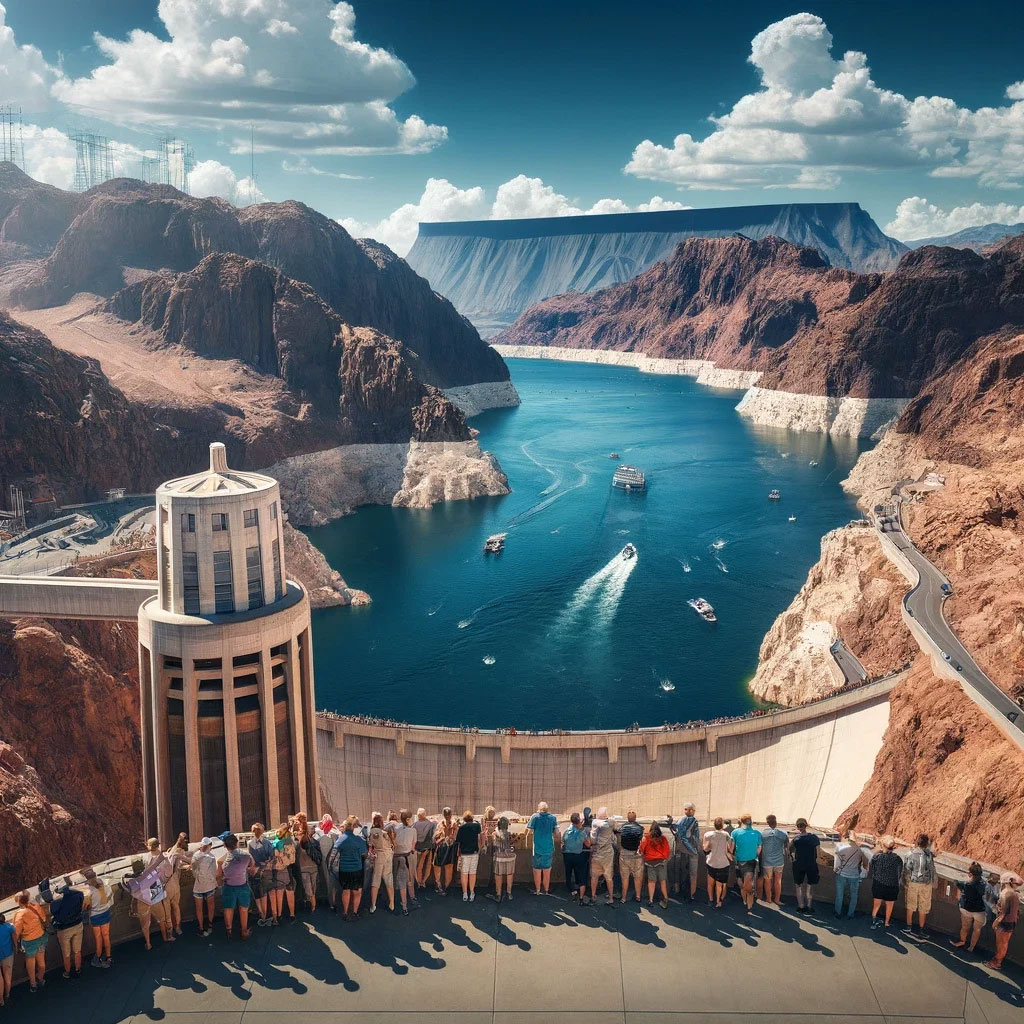
There’s a “white ribbon” that goes around the entire edge of Lake Mead—-we locals call it
the “bathtub ring”—-and it’s a visible feature from the airplane above. While it doesn’t look like
it, that bathtub ring is a 15-story building in height … about 150’. So if the question is, “How
low is Lake Mead?” About 150’. Or put another way—-and I rarely tell the guests on my tours
because it makes me sad—- Lake Mead is more than two-thirds (2/3) empty.
Las Vegas is only one of several desert communities that has benefited greatly by its
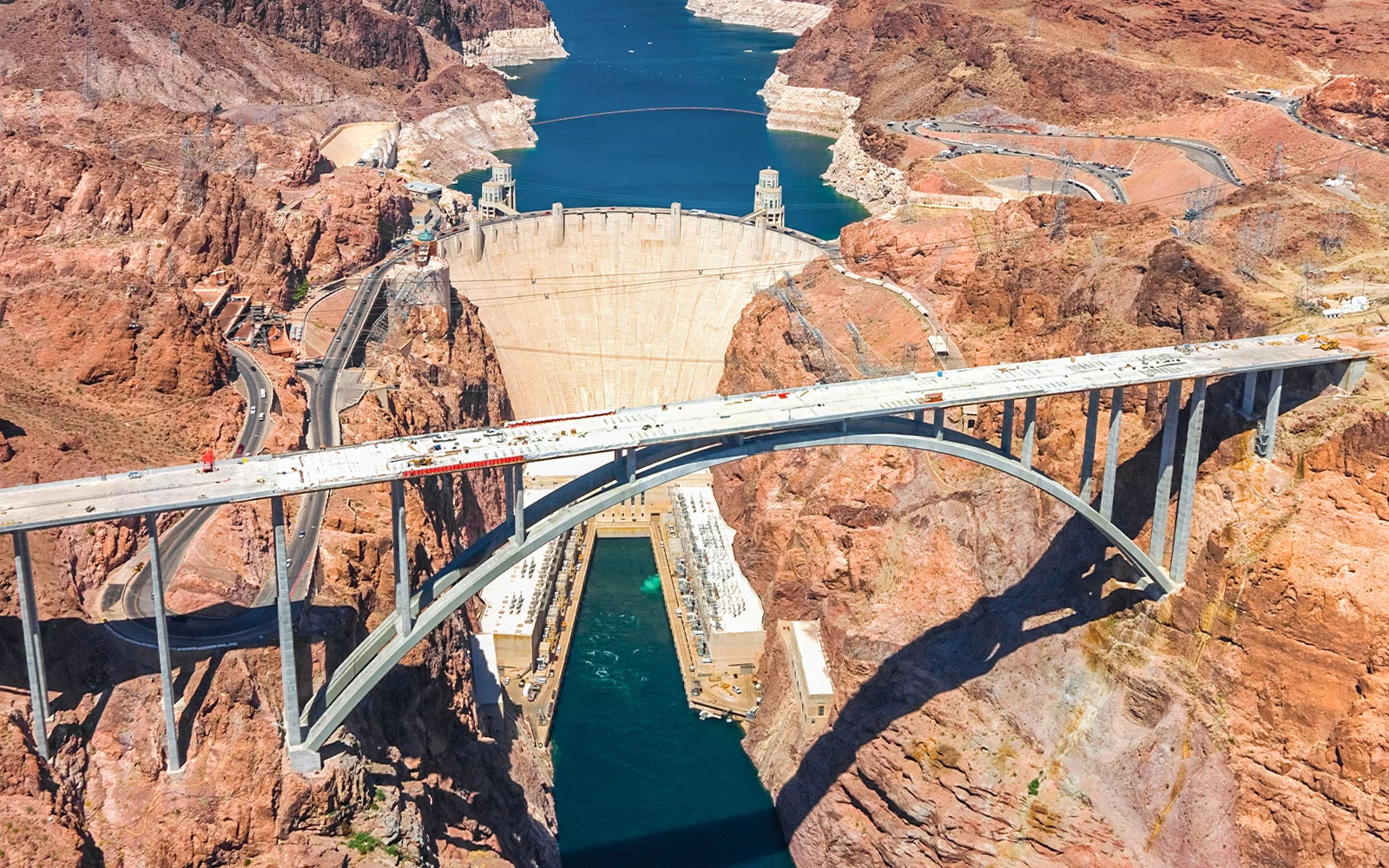
proximity to the Hoover Dam. Its massive 70-plus-stories-in-height concrete face and gigantic
electrical generating turbines and power plants lie just 35 miles southeast from the Las Vegas
Strip.
The main source of water for Lake Mead is the Colorado River which originates in the Rocky
Mountains of Colorado. Snow melt is the river’s main source. The natural river flow is blocked
by the dam situated at the Black Canyon, and a new lake was created where no lake existed
before.
Interesting little tidbit: with water weighing about eight pounds per gallon, and the new
lake filling up with about two years of river flow, it filled the new lake with about two-thirds of
a trillion gallons of water. In fact, the weight of the new lake caused the earth’s crust to shift
that resulted in a series of small-magnitude earthquakes.
It’s quite astonishing … when you consider that cities like Los Angeles, San Diego, Phoenix,
Tucson, Denver, Las Vegas itself, Salt Lake City—-none of these cities would have grown to
anywhere near their current sizes were it not for the Hoover Dam and Lake Mead. Why? They
all depend on the water for their basic survivability. Water to drink. Water to bathe. Water to
irrigate your crops. Water to do your laundry … wash your dishes. That’s a tall order. I’m not
saying that’s their only source of water, but it’s one of their main sources.
Think About that Shower You Took Today
A resident goes to the kitchen and turns the faucet; water appears. They go to the shower
and turn the handle. Bingo! Water appears magically. And that’s all they need to know about
water. Think about that shower you took earlier today. Now multiply that by 35 million. The
Hoover Dam allowed the American Southwest—-including Southern California—-to grow and
prosper beyond anyone’s wildest dreams.
It should be noted the city of Las Vegas recycles at least 93% of all indoor water. They didn’t
start this last year. They didn’t start this five years ago. They’ve been doing this since the 50s.
Las Vegas was one of the first cities to engage Israeli water engineers and learn how to better
manage water systems. Israelis also live in a desert, and they’ve learned how to squeeze every
drop of water out of every conceivable source. They’re among the best in the world.
Why did Las Vegas Invest a Billion Bucks to Build a “Third Straw”? What is it?
Las Vegas is a big valley that sits near the center of the Mojave Desert—-a vast ecosystem
with a 5-state reach. Less developed desert landscapes look the same way they did
thousands of years ago. Deserts are the driest places on earth, but to make matters worse,
this entire region has suffered one of the worst droughts in the past 150 years. In the past 20
years, some years have yielded as little as 2” of rainfall. Some places get that in an hour.
Gauging the seriousness of the matter and wanting to avert a water crisis, the City of Las
Vegas undertook, in 2008, a bold and challenging billion-dollar project known locally as the
“Third Straw”. It was one of the largest public works projects in the city’s history, and fell under
the guidance and direction of SNWA (Southern Nevada Water Authority). The official title:
“The Third Intake”.
They dug 600’ straight down, then bored a three-mile-long tunnel through extremely hard
volcanic rock beneath Lake Mead. This was to ensure that Las Vegas residents continued to
receive water. The other two existing intakes sat at a higher elevation, and would not be able
to pump water if the lake reached “dead pool” … historically low levels that we were
dangerously approaching. The project was completed in 2015 and has been a huge success,
The Carlsbad Desalination Plant
Coincidentally—-or perhaps not—-California built its first “desal” plant in decades. It too was
completed in 2015. Remember, Southern California is part of that same Mojave Desert ecosystem,
and, Southern California receives both water and electricity from Lake Mead, and the
Hoover Dam. With regard to electricity: CA consumes 56% of the power produced at the
dam, Arizona, about 19%, and Nevada, about 25%. With respect to the water, CA consumes
more water than the other six (6) states combined. We’re talking Southern CA.
The Carlsbad “desal” plant (Claude “Bud” Lewis Carlsbad Desalination Plant) produces
about 54 million gallons a day of fresh, clean, crystal-clear drinking water for the San Diego
residents.
When the City of Las Vegas initiated the “Third Straw” project, it was designed to completely
bypass the original shallow intake towers. Rather than feeding into the older higher elevation
network, the new tunnel infrastructure was designed to access water for Southern Nevada
residents below Lake Mead’s “dead pool” elevation of 895 feet. At this point no water can
pass through Hoover Dam to generate electricity, nor meet downstream water demands in
California, Arizona and Mexico. The third intake sits below the lake itself, and routes water to
the Low Lake Level Pumping Station on Saddle Island.
California was surely aware of all of the foregoing, and took bold measures itself to mitigate
future water shortages. It is not a coincidence that both projects were completed in 2015.
How the Hoover Dam & Lake Mead Helped Win the War
California and Nevada are linked together not just by geography and economic necessities,
but also by historical events. There’s another lasting legacy of the Hoover Dam, though much
less known. Its enormous electrical generating turbines powered the manufacturing that
helped the U.S.—-and her allies—-win WWII. How so? Southern California factories were
converted into a manufacturing powerhouse that produced military aircraft, combat vessels,
light tanks, aviation fuel & oil, and hundreds of other products that kept our front lines and the
war effort supplied.
Guess what? Those factories needed two things to operate: they needed water and electricity
… and they got the water from Lake Mead, and they got the electricity from the Hoover Dam.
Will We Run Out of Water?
Las Vegas is a “Pro-Growth” city and there is building going on everywhere. New housing
tracts are springing up like mushrooms. In 1990, the population of Las Vegas was 275,000
Today, it’s approaching three million. An impressive 10-fold increase in population in just 36
years. Other desert communities such as Phoenix and Tucson, AZ, are also enjoying doubledigit
growth rates. All of this begs the question, “Are we going to run out of water? “
I’ll answer this way: If we don’t take further bold steps to mitigate what is obviously a water
crisis in the making, then it’s like driving our cars towards a steep cliff. It is not going to end
well. However, I don’t believe that we as a people will allow that to happen.
Why CA Is the Key Piece In the Water Jigsaw Puzzle
CA has always played a significant role in the past, and will continue to play a critical role in
the future with regard to water needs, and the severe drop at Lake Mead. As stated, Southern
California alone consumes more water than the other six (6) states combined.
Here’s why CA holds the key piece to our water future: they have an impressive body of
water to its west—-the Pacific Ocean.
If the climate change people are correct that ocean levels are rising due to the ice caps
melting, then doesn’t it make even more sense to build more desalination plants up and
down the Southern CA coastline? At least another 10 for starters. U.S. companies have been
building them for the Saudis and other nations around the world for decades. We should
build more of them for ourselves.
Not a Question of If … but When
Once these desalination plants are up and running, they will be able to supply the enormous
water demands of Southern California farmers and their agricultural production. This is mainly
for the Imperial & Coachella Valleys that are heavily dependent on Colorado River water. As a
side note, domestic consumption of water is a small fraction of what our great farmlands use.
These new desalination plants will take an enormous strain off of Lake Mead, as California
greatly reduces its need of Colorado River water. The lake will return to its former “full pool”
levels of the mid-80s. Lake Mead will then be able to more generously supply the water
demands of the other six (6) states for decades to come.
We Could Do So Much More
Another thing—-the three “lower basin states”; California, Nevada & Arizona, along with the
four “upper basin states”; New Mexico, Colorado, Utah & Wyoming, should all enact
legislation requiring all new housing starts to develop and incorporate rainfall-capture
technologies that are connected to 500- or 1,000-gallon underground storage tanks. This
water can then be used for garden use and lawn irrigation. Every drop helps, right? I believe
the great state of CO, and possibly other states too, have archaic water rights laws on the
books. The laws state that the rainfall doesn’t belong to you, it belongs to the Colorado River.
This is absurd. What if you live 20 or 50 or 100 or 200 miles from the river? These laws need
to be revised to reflect 21st century realities. This is just one idea.
Last point, regulatory red tape needs to be cut in half. The Carlsbad desalination plant took
10 years to get all the approvals. I’m not sure that we have 10 years. Plus, I don’t think there
are any politicians, or environmentalists, who don’t like to take showers!
John Robert Adair is a licensed tour guide with Mr Las Vegas Tours. He was the first tour guide hired by
the company in 2017. If you are visiting Las Vegas and you book a tour, make sure to ask for John by
name.
He is also a published author of two books: Chess Basics and Conceptos Basicos del Ajedrez, and has a
third book, Just Saying due out by end of Aug. 2026. This is a thoughtful collection of his favorite quips
and quotes.
P.S. He’s been to the Hoover Dam more than 2,000 times, yet he treats every visit as though it were his
first.